


Independent OSCE Moscow Mechanism experts: Russia’s systematic militarization and indoctrination of Ukrainian children, along with their forcible transfer and deportation, may amount to crimes against humanity
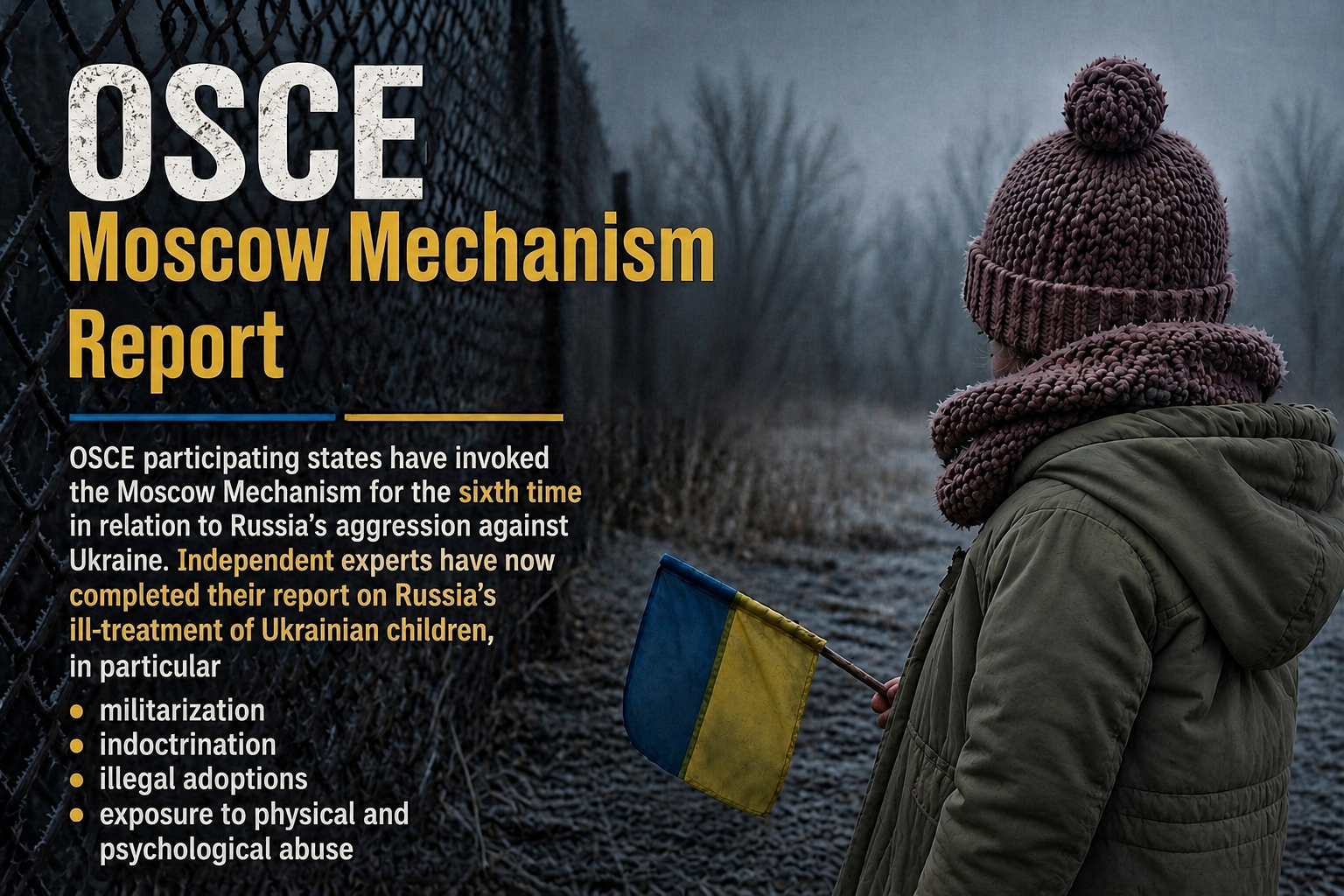
On July 9, at the Permanent Council of the Organization for Security and Cooperation in Europe (OSCE), experts from the mission, established under the OSCE Moscow Mechanism, presented their Report on Violations and Abuses of International Humanitarian, Human Rights and Criminal Law related to Militarization and Indoctrination of Ukrainian Children by the Russian Federation.
The Mission found that the Russian legislative architecture governing Ukrainian children in occupied territories constitutes a system of purposeful design. First implemented in Crimea since 2014, it was expanded to all occupied territory since February 2022, with further strengthening and reinforcement. This architecture intertwines education law, youth policy, family law, citizenship regulations, and legislation on terrorism and extremism to produce a coordinated mechanism of indoctrination and militarisation, as well as of suppression of any dissent.
The Report states that indoctrination operates across every level of the school system in the occupied territories. Russian curricula have entirely replaced Ukrainian educational content, and Ukrainian-language instruction has been formally eliminated. History textbooks promote Russian civilisational supremacy and erase Ukrainian national identity. The weekly compulsory programmes, starting from kindergarten age, embed pro-war narratives in ordinary school life, while cadet classes and military-patriotic youth organizations extend pre-military preparation.
The Experts noted that militarization extends beyond the classroom through State-sponsored military-patriotic youth organizations and re-education camps. Membership in these organizations generates admissions advantages at military universities, and special centres provide structured training in weapons and UAV operation for children aged 14–18. Conscription completes this pipeline: Ukrainian boys in the occupied territories, in particular, receive pre-conscription notices as young as 16, and conscription is imposed upon reaching 18, in direct violation of the prohibition on compelling protected persons to serve in the armed or auxiliary forces of the occupying State.
The Mission found that the system is enforced through pervasive coercion. Parents who refuse to enrol their children in Russian schools are threatened with deprivation of parental rights; law enforcement agents accompany school officials on house-to-house visits to compel compliance. Teachers who decline to implement the Russian curriculum face dismissal, harassment, house searches, and detention. Children are forbidden to speak Ukrainian in schools or public spaces; those who express pro-Ukrainian views — including on social media — face searches, interrogation, and even prosecution. Coercion to acquire Russian citizenship is exercised by denying access to care and social services, to education, to daily matters such as banking services, and restricting freedom of movement to those without Russian documents.
The Experts concluded that Ukrainian children have suffered the consequences of serious violations of international humanitarian law and international human rights law, including violations of the rights to identity, family, education, information, freedom of thought and conscience, health, and the right to liberty and security of person. The Report states that practices of systemic indoctrination and militarisation, and the forcible transfer and deportation of Ukrainian children may amount to crimes against humanity. The Mission concludes that the best interests of the child were disregarded in every dimension of Russia’s policy.
The Experts emphasised that forcible transfers and deportations of Ukrainian children remain among the gravest violations documented, and endorsed the determination of the UN Independent International Commission of Inquiry that the forcible transfer and deportation of Ukrainian children may also amount to a crime against humanity. Children deported to Russia have frequently been placed in foster families or subjected to adoption under Russian law. The Russian Federation has systematically obstructed family reunification while failing to establish any mechanism for restoration of identity, as required by international law and as recommended by the 2023 Moscow Mechanism mission.
Moreover, the Mission identified probable war crimes, including torture and inhuman treatment, causing great suffering to children.
The mission noted the so-called Russian “re-education camps” in Belarus documented by non-governmental organizations, and emphasised that the institutional network used by Russia for the indoctrination and militarization of Ukrainian children is thus no longer solely a Russia-internal affair but has developed an international dimension that implicates third states in Russia’s criminal practices.
Lithuania, with its partners and international organizations, continues to actively work toward the return of deported Ukrainian children. Our goal is to ensure that every child is returned to their family and community, and protected from repression by the occupying authorities. We also support international mechanisms designed to document Russia’s crimes, in order to ensure that Russia is held fully accountable for its war of aggression against Ukraine.
One of the OSCE’s Human Dimension instruments—the Moscow Mechanism, aimed at assessing war crimes and crimes against humanity committed following Russia’s invasion of Ukraine— has been activated for the sixth time at the initiative of 41 OSCE participating States, including Lithuania, with Ukraine’s support.
Reed the full Report here.
