


Director General of the IAEA Promises Organizational Support to Build a Modern Nuclear Power Plant in Lithuania
President Valdas Adamkus, currently on a visit to Vienna, met Dr. Mohamed ElBaradei, Director General of the International Atomic Energy Agency (IAEA). President Adamkus told Dr. Mohamed ElBaradei that Lithuania had plans to further develop nuclear energy. “Together with the neighboring countries of Latvia, Estonia and Poland, Lithuania intends to build a third modern nuclear reactor,” said Mr. Adamkus. “We are making a joint effort to create a regional energy security model.” Valdas Adamkus underlined that it was very important for the Baltic region to integrate into Western energy systems. Lithuania and Poland were working together on a project to build an energy bridge to the West, which carried significant weight for enhancing the energy independence of the Baltic region. Dr. Mohamed ElBaradei pointed out that the joint decision made by the Baltic countries was justified, creative, and promising. “The IAEA is ready to provide any support required to resolve nuclear energy development problems,” said Dr. ElBaradei. President Adamkus thanked him for continuous technical assistance and expressed hope that the IAEA would also help Lithuania deal with the problem of nuclear waste. The Lithuanian president and the Director General of the International Atomic Energy Agency also discussed Iranian and North Korean nuclear programs and touched on the issue of nuclear non-proliferation. Mr. Adamkus emphasized that Lithuania would enhance its activities in the IAEA by becoming member of its Board of Governors in 2007-2009. President Adamkus presented a gift to Dr. ElBaradei: a picture reflecting on nuclear disarmament by the Lithuanian artist Rimvydas Bartkus who currently lives in New York.
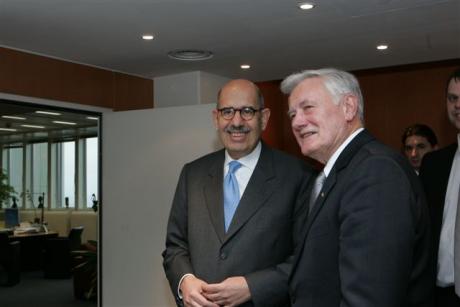
President Adamkus told Dr. Mohamed ElBaradei that Lithuania had plans to further develop nuclear energy.
“Together with the neighboring countries of Latvia, Estonia and Poland, Lithuania intends to build a third modern nuclear reactor,” said Mr. Adamkus. “We are making a joint effort to create a regional energy security model.”
Valdas Adamkus underlined that it was very important for the Baltic region to integrate into Western energy systems. Lithuania and Poland were working together on a project to build an energy bridge to the West, which carried significant weight for enhancing the energy independence of the Baltic region.
Dr. Mohamed ElBaradei pointed out that the joint decision made by the Baltic countries was justified, creative, and promising.
“The IAEA is ready to provide any support required to resolve nuclear energy development problems,” said Dr. ElBaradei.
President Adamkus thanked him for continuous technical assistance and expressed hope that the IAEA would also help Lithuania deal with the problem of nuclear waste.
The Lithuanian president and the Director General of the International Atomic Energy Agency also discussed Iranian and North Korean nuclear programs and touched on the issue of nuclear non-proliferation. Mr. Adamkus emphasized that Lithuania would enhance its activities in the IAEA by becoming member of its Board of Governors in 2007-2009.
President Adamkus presented a gift to Dr. ElBaradei: a picture reflecting on nuclear disarmament by the Lithuanian artist Rimvydas Bartkus who currently lives in New York.
